
Thinking through Martyrdom in Project Hail Mary
Off the cuff thoughts on a pretty good jesus movie

Hail Mary, full of Grace,
The Lord is with thee.
Blessed art thou amongst women, and blessed is the fruit of thy womb, Jesus.
Holy Mary, Mother of God,
Pray for us now, and at the hour of our death.
Amen.
I saw Project Hail Mary the other night, and it was pretty good! Sarah Salviander’s piece on it made me want to write my take on the title/protagonist name thing, which… sorta spiraled into a longer piece.
Project Hail Mary is a movie (mostly) about one man, Dr. Ryland Grace, an astrobiologist resigned to teaching middle school science after staking his career on an unpopular thesis. The details of this are vague and ambiguous; what’s sketched out is the story of a brave truthteller shut out by the establishment as told by an antisocial man rejected for being abrasive to those who don’t recognize his genius.
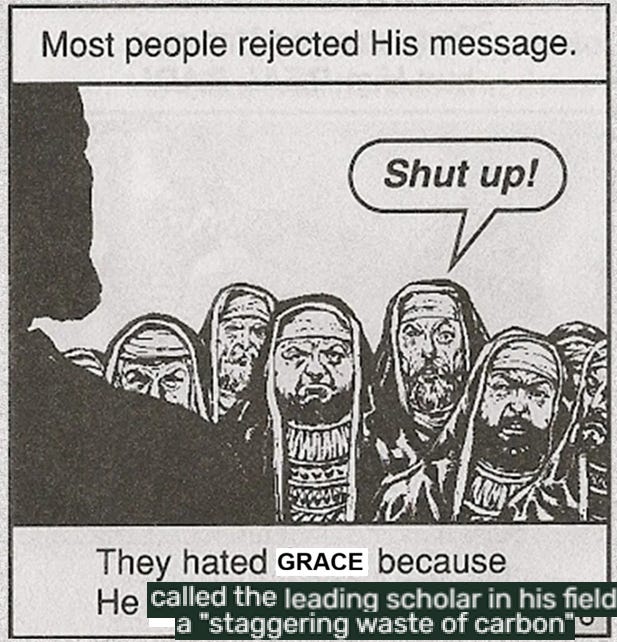
He’s recruited to save the world by the titular transnational Project Hail Mary, so-named (presumably by the Americans) because there’s not going to be a second shot.
Joseph Holmes writes that Gosling’s Ryland Grace is a masculine hero. Shut out and demoralized as much by himself as by others, he is redeemed by his tenacious application of technical skill to better the lives of others. There’s a sense in which the realization of his true character, revealed under the pressure of crisis, makes him the hero that even he did not believe himself to be. I think that’s all true.
But like, the film cries out for a religious reading. The Hail Mary is full of Dr. Grace—at the start, he’s the only passenger who’s survived the first leg of the mission. He looks like this:
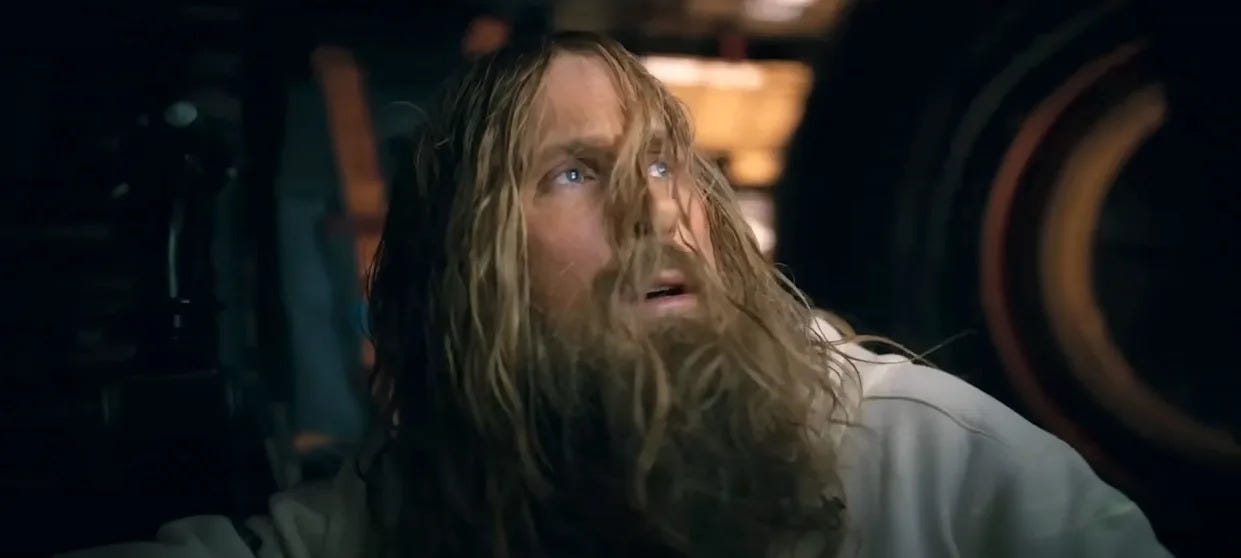
Project Hail Mary is a Christmas Christian movie. The question is what it’s doing with these images.
If we’re trying to locate Grace (the idea) in the film, we can tweak the summary above. Ryland is given a chance of redemption by the hand of providence, and the strength of character to meet that trial when it comes. It’s easy to read the work of the Holy Spirit into these circumstances. The prayer referenced by the film entreats for intercession at the hour of our death—when you leave everything on the field.
Dr. Ryland Grace is not coming back from his mission. He has just enough fuel to approach Tau Ceti1 and figure out how it has survived whatever is eating our sun. Whatever he finds will have to be sent back as messages in bottles. He knows he is going to die; if everything goes well, his death will allow many others to live. His heroic trial is a martyrdom.
Marcus Pittman has a good review over in the Federalist which draws out some of the Christian symbols in the film. I think you could go pretty far with this—Ryan Gosling asking to glimpse the interior of the alien ship before the end feels like a saint’s revelation, which … what does that make Rocky?—but I prefer to say that there are parallels with Jesus’ passion in the same way there are in any story of martyrdom, because martyrdom is a Christ-like act.
Thomas said to him, “Lord, we do not know where you are going. How can we know the way?” Jesus said to him, “I am the way, and the truth, and the life,” (John 14:1-7). The Christian aspires to emulate the example of Christ. While mindful that no human being can match the sinless goodness of God (Matt. 19:17), all are called to walk in love as Christ loved us—notably including the fact that he gave himself up for us (Eph. 5:1-2). Many, many saints have stories like Ryland Grace, a moral redemption by way of giving oneself up for others, by which they become a “type” of Christ.2 So, martyrs are highly venerated in Christian tradition, and the act of suffering deeply theorized.
The Martyr’s Affect: “I go singing home to God.”
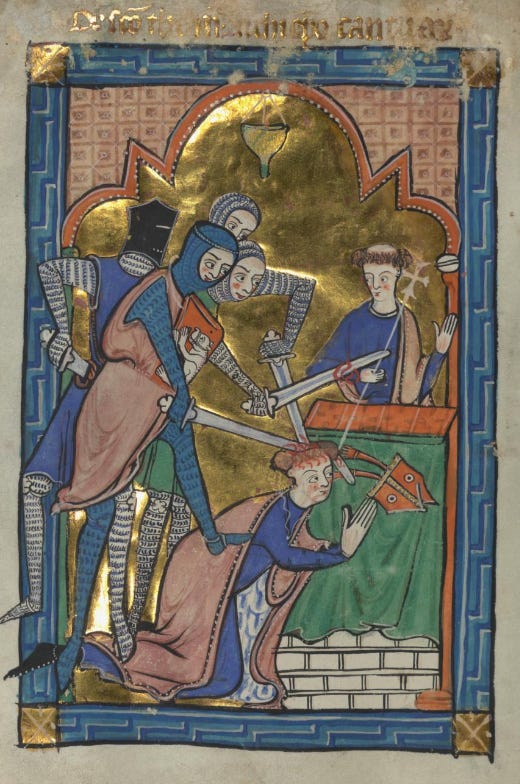
Paul writes of Jesus’ life and crucifixion that he emptied himself, taking the form of a slave, assuming human likeness, and he humbled himself, and became obedient to the point of death—even death on a cross (Phil. 2). Kenosis—emptying oneself—and obedience unto death are key concepts in martyrdom. The righteous martyr is kenotic, acting without self regard. It’s easy, given all the veneration of innumerable martyrs, to see how Christians might’ve started worrying about glory seekers running off to death, so you have writers like St. Thomas Aquinas clarifying that imprudently trying to get yourself killed out of vainglory is not the same thing as martyrdom, which must instead spring from an honest charity toward others. In a sense, the martyr is less motivated than they are obedient to the will of God. My understanding is that this concept echoes a Jewish one, of “being killed rather than transgressing.” The image in my mind is that of St. Thomas Becket, the archbishop of Canterbury put to death by agents of the King. When these knights arrived to arrest Becket, he continued on his way into the cathedral, preventing monks from attempting to bolt the doors, admonishing them for “mak[ing] a fortress out of the house of prayer.” Becket died clinging to a pillar so as not to be dragged out of the church, his head bowed in prayer.
The willingness of martyrs, the acceptance of their death, is a recurrent feature of their iconography. Sometimes this is the simple (if unbelievable) strength of obedience, even unto death, of Thomas Becket. In other cases, it’s downright flamboyant, as with St. Lawrence who, burned to death on a gridiron, is said to have asked to be turned over so as to be cooked evenly.3 Hence, a lot of illuminated manuscripts featuring saints placidly smiling as a sword cuts through their head, etc.
There really isn’t a way to discuss this film further without heavy spoilers. So, after the cut,4 why the end of the movie complicates things.
Over the course of the movie, the audience is left to wonder what, exactly, Dr. Ryland Grace is doing here. He’s vitally important in the research into the astrophage which the mission is attempting to address. But the mission is into deep space, and he is not an astronaut; we see in flashbacks that a qualified team is put together to apply his findings out by Tau Ceti. It’s not until we’re almost at the very end that we learn the truth: Grace didn’t volunteer to be here. The scientist meant to go died in a freak accident, and a replacement was needed, and only one existed. He refused to go, and was forcibly subdued, strapped into the ship, and placed into a medically induced coma along with his two more willing compatriots.
Kat Rosenfield a while back wrote that “The thing that distinguishes a martyr from a casualty of war is desire: the martyr wishes for death, while the casualty is killed while trying to escape it.”
When we think of martyrs, we think of Becket’s obedience, Lawrence’s quips. We think of St. Sebastian, who was martyred twice, because after the first execution didn’t take, he went to shame the Roman emperor directly for the persecution of Christians, knowing full well that his guards would finish the job. We don’t tend to think of Dr. Ryland Grace, literally kicking and screaming, climbing cabinets to get away from his responsibility. Martyrdom is an acceptance of the call, not a refusal of it.
I think that this is wrong. At least, I think it’s confused.
The prudence of martyrs is debated. Lots of sainted martyrs, to modern secular ears, seem a bit hasty to die. But, as Thomas pointed out, there’s a very key distinction between accepting one’s fate, even walking willingly toward it, and affirmatively wishing for death. Peregrinus Proteus is the kind of guy I think of as “wishing to die.” He was a cynic and apparently former Christian who gave his own funeral oration before leaping onto a burning pyre; a pagan cult was established in his memory. This feels like someone who is more motivated by a desire for greatness than an obedience to God. Martyrdom, “which consists in the right endurance of sufferings unjustly inflicted,” is very often not willingly stepped into whatsoever.
The 21 Martyrs of Libya, reported Christian construction workers beheaded by ISIS members on camera, were kidnapped victims of murder. Rev. Martin Luther King, Jr. was (I would claim) a martyr, and even the day before his death said “Like anybody, I would like to live a long life. Longevity has its place. But I'm not concerned about that now. I just want to do God's will.” But no one would argue he wanted to be shot the next day (and he had already survived attempts on his life before).
It was hard to imagine Becket as actually calm as he was hacked apart, when I stood in Canterbury Cathedral. Even Christ himself prayed that the martyr’s cup might be passed from him, and hanging from the cross cried out, “My God, my God, why have you forsaken me?”
“Time go fishing,” or: Jonah tried to run, too.
Tau Ceti is an interesting choice for this movie. Tau, the Greek letter, is of course shaped like a T—that is, like a cross, and the “tau cross” is a specific symbol with multiple meanings in Christian history. Tau Ceti is so labelled as one of many stars in the constellation Cetus, which we call “the Whale.”
So, in other words, our hero has wound up at the cross in the belly of the whale. Interesting! Because—recall footnote 2—Christians have historically seen Jonah of fishy fame as prefiguring Christ. Swallowed by some sort of sea creature, he survives three days and three nights before he is vomited out at God’s command. Jesus himself is reported to have made the obvious comparison:
For just as Jonah was three days and three nights in the belly of the sea monster, so for three days and three nights the Son of Man will be in the heart of the earth. (Matt. 12:40)
Jonah had been commanded by God to go to the city of Nineveh, to spread the news of God’s judgement upon it. But Jonah set out to flee to Tarshish from the presence of the Lord (Jonah 1:3). The ship he charters to flee God’s commands is set upon by storms, which cease only when the crew throws Jonah overboard, whereupon he is swallowed. He only goes to Nineveh after he is spat out, three days and three nights later.
Likewise, Ryland never wants to go on the mission commanded of him. He refuses, and is stuffed down inside of his ship. Entirely against his will he is brought to his trial. Like Jonah, he runs when he is commanded. Like Jesus, he is sentenced by earthly authority to his fate, bound to it.
When Jesus is brought to his cross, he descends into the heart of the earth, Harrowing Hell, freeing from the clutches of death those faithful who came before him. When Jonah is swallowed, he begins to pray, and promises obedience to God.
When Ryland is brought to Tau Ceti, in the heart of the Whale, only then does he empty himself, becoming obedient even unto death, to offer himself that he might free the world from death.
And even then, not really. I think my favorite scene in the movie comes when Grace reluctantly reveals to Rocky that he is going to die. He tells Rocky he’s made peace with this, but it’s belied by the fact that he felt the need to lie about it. Rocky offers him a way home, and he breaks down—he tells us, “I didn’t mean any of that.”
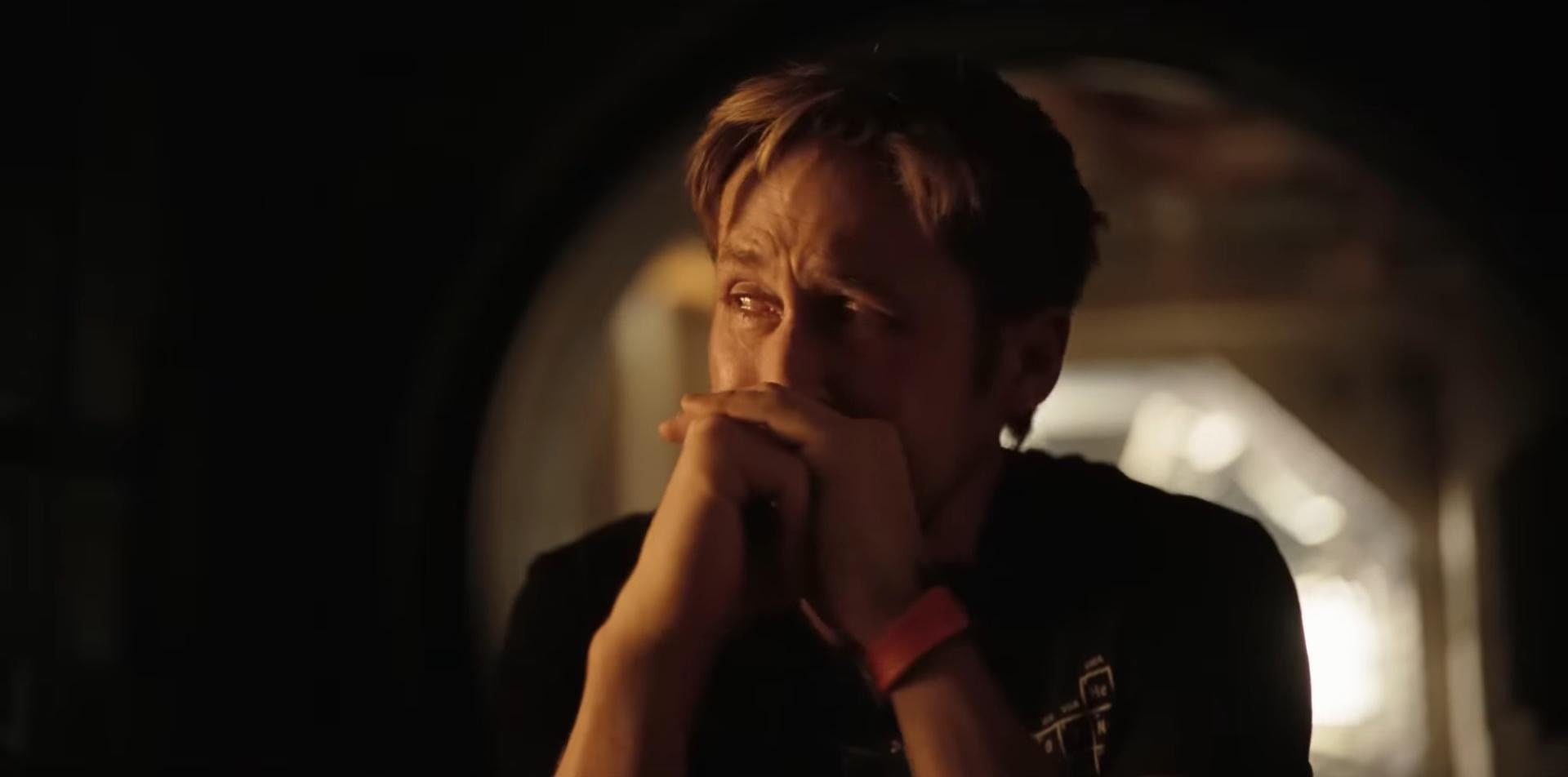
I think this representation of martyrdom is actually more Christian—by which I mean humanistic—by which I mean empathetic. What are we talking about, wishing to die? No one wishes to die, all things being equal. That’s why it’s a meaningful sacrifice to accept that one will. It is, as Thomas writes, an act of fortitude, an endurance of sufferings unjustly inflicted.
Suffering, said Rev. King, Jr., can be redemptive. As Jesus’ suffering of all sins and death assures the faithful of his ultimate empathy and co-suffering in dark times, when we suffer with others we’re engaged in a sacred encounter. It’s holy work, as attested to by the unshakable bond built between Rocky and Ryland, who come to see each other with an intimacy only survivors know, a foundation of a deep and (thankfully) ongoing love.
Being on the spot, on the cross, in the belly of the beast, is never only one thing, I think. I have a hard time saying I only ever feel one thing about most mundane happenings in my life. Our feelings are jumbled and the consequences of our actions are innumerable, unknowable. It seems deeply unfair to me to say that someone’s resistance to death subtracts from the merit of their co-occurring willing positioning of themselves to suffer for the protection of others.
People, moreover, are never only one thing. The whole point of Grace is that they can always remake themselves—or, in the Arendtian framework, they can always make something new, if we let them, regardless of what they have done before. Whatever Ryland’s sins have been, they do not define him. Nor does his heroism as a martyr. He is beyond something like definition; I can’t really tell you more about it, because I’m not Rocky. I only have a simulacra of that empathetic encounter.
“Um, ackshually, he DOESN’T EVEN DIE”
While I disagree with Kat on how to assess if one counts martyr, it is the case that internal experience matters in defining one. What we honor in the martyr is the suffering they took on on our behalf.
So, the fact that Ryland doesn’t die is an issue. Didn’t really sacrifice that much in the end, right?
I think audiences are impacted by his actions because he fully believes he will be killed. It’s hard to argue he has not emptied himself, has not committed fully to giving his life to the salvation of others, just because Rocky acts to save him.
Aquinas again:
Reply to Objection 4: The merit of martyrdom is not after death, but in the voluntary endurance of death, namely in the fact that a person willingly suffers being put to death. It happens sometimes, however, that a man lives for some time after being mortally wounded for Christ's sake, or after suffering for the faith of Christ any other kind of hardship inflicted by persecution and continued until death ensues. The act of martyrdom is meritorious while a man is in this state, and at the very time that he is suffering these hardships.
The point is that he is given this challenge, and rises to it. Whether or not he is rewarded afterward by having the fully-believed inevitability of death reversed is not relevant in judging his decision making before that point.
hey isn’t tau shaped kinda like a — put a pin in it
Esp. popular in the Middle Ages, there’s a Christian tradition of seeing figures before Jesus as prefiguring him—Adam, Jonah, Moses, etc. are seen as types of Christ. So, strictly speaking, martyred saints are antitypes, but that doesn’t have the same ring to it.
See also Giles Corey, crushed by stones, whose last words were said to be “More weight.”
ha, ha
This was lovely. Regarding the Jewish idea of martyrdom, since that came up in a note directed to me: we usually say that Kiddush Hashem, the requirement to "sanctify God's name," can entail martyrdom if a Jew is otherwise going to have to break one of three big Laws (which aren't exempt under pikuach nefesh, the principle that otherwise overrides the Law in life or death situations). I'm not sure it's totally aligned with the Christian idea of Jesus, but we definitely have an idea of redemptive sufferers like the traditional idea of Mashiach ben David having a disease. If you want a classic on the topic I'd recommend Rambam's Maamar Kiddush Hashem! Anyway loved this.