

I just read Barry Lam’s April piece, “The Missing Genre: Why Political Philosophers Should Be Writing to get Netflix deals,” and I violently agree.
Political philosophers should do something more ambitious, such as create and sustain a genre about radically different political systems and show people how it feels to be inside of them, the very kind of thing that engages people when they watch Sarah and John Connor confront the iterations of Skynet over the course of the last 40 years. We should invent Poli-Fi, and make it as sloppy and interesting as sci-fi.
I have a couple disorganized thoughts on this subject I wanted to quickly write down. This is basically just an overview of what I’ve been thinking about lately, true off the cuff style. I don’t know that there’s much additive here, but hopefully it’ll introduce you to something you hadn’t yet read.
Social Science has always ruled SF
Ok, well, maybe not. But I would argue that what Barry calls “poli-fi” exists in a form going way back, which I’ve mentally referred to as “Social Science Fiction,” because it’s a bit more expansive than his technical definition.
Off the top of my head—in SF “antiquity,” we have works like The Time Machine (1895) and Metropolis (1927) which are really more about class than they are science, the former giving us Morlocks and Eloi and the latter the Luciferian megalopolis and its trammeled masses. Getting into the Pulp era—Lovecraft, of Weird Tales infamy, was interested in civilizational decline and relations between Others more than anything else, and his influence rebounding through horror and weird fiction is a staple of the SF landscape today; later, Welles’ 1938 adaptation of The War of the Worlds literally instigated a miniature socio-political upheaval!
But once we reach the maturation of the Golden Age and its descendants, I think we see in the titans of SF a clear tendency toward social systems exploration. Particularly in their greatest, enduring works, I think Lam’s definition of “Poli-Fi” is met:
a genre of fiction that treats political systems themselves as the primary speculative variable in a fictional narrative.
Limiting things strictly to agreed-upon science fiction which does not merely “[critique] existing systems (dystopias), or [dramatize] familiar structures like elections or corruption or dynasties,” the key works in my mind:
Isaac Asimov’s Foundation series (1942-1950) invents a social omni-science, psychohistory, as its speculative variable—what if the sciences of psychology, sociology, and statistical analysis enabled future prediction in the way we can analyze history as the interplay of material conditions, institutional structure, and culture?
Frank Herbert’s Dune (1965) and its sequels ( -1981) are riffing off the same question with its “Golden Path,” as well as analyzing the role of religion as a collection of social technologies and a political tool, and entertaining complex questions about the agency of Great Men from a perspective that distrusts them.
Robert Heinlein tread this ground quite a bit—The Moon is a Harsh Mistress (1966) is remembered for its innovative use of “rocks + gravity” as WMDs, but is about a Lunar colony of polygamist libertarians holding off Earth invasion. 1

My favorite works, the ones I think most fully fit this description, are those of Ursula K. Le Guin. Her Hainish cycle is, effectively, a series of social/political scientific thought experiments, segmented on different planets.
The Left Hand of Darkness (1969) explores a society without gender through the eyes of a male Terran (and is really good).
But the work that I think most fully embodies “Poli-Fi” as defined—that is, not just political, but about speculative politics, comes later:
The Dispossessed: An Ambiguous Utopia (1974) is more or less explicitly what Barry is suggesting. le Guin wrote the book after reading the great anarchists and realizing “that nobody had yet written an anarchist utopia,” explores the twin worlds of Anarres (anarcho-communistic) and Urras (dominated by the capitalist power A-Io). What I think really elevates this book is the fact that Anarres is not utopian. It’s a society marked by the abolition of family, property, and prison, with an intentional effort to artificially construct a more collectivist culture and to engineer a centralized but non-authoritarian economic system—basically an atypically successful “utopian society” as well-known in America—but it’s also a ramshackle frontier society, struggling with the implications of these dreams, dealing with its own internal tensions. We follow a main character who navigates the academic politics of that society at home, and who experiences more Earth-like Urras through the lens of that background.
This section is getting too long; how much do I even need to say about the cyberpunk of William Gibson, or the weird fiction of China Miéville?
The relevance and urgency of SSF today
Here are a couple of other recommendations for you:
Red Plenty (2010) by Francis Spufford is emphatically not science fiction, but it really feels like one to me. It’s a historical fiction about the attempt to make a centralized economy work through the application of cybernetics, and the issues that ran into. Henry Farrell has pointed out its contributions to what author Hari Kunzru has called the A.S.T. or “apocalyptic systems thriller,” which both agree is a major element of SF today.
Multi-stranded, terse, often anchored in character just enough to drive the action forward, these books invite us to take an elevated, panoramic view of events that extend too far in space and time to be grasped by a single narrative consciousness. Conflict, climate change, pandemics and natural disasters offer ways to contemplate our interconnection and interdependence. At its best, this kind of fiction can induce a kind of sublime awe at the complexity of the global networks in which we’re enmeshed: A butterfly flaps its wings in Seoul and the Dow crashes; a hacker steals a password and war breaks out.
In my reading I’m cognizant of the influence of thrillers on Stephenson and Gibson.2 When this use of genre to explore social reality becomes “panoramic” one is able to truly grapple with the pressing political scientific questions of our era, as in speculative war scenarios (2034 [2021]) or, as Farrell argues, literal social science writing (his Underground Empire [2023], Tooze’s Crashed [2018]):
My toy theory is that this new genre came into being before the era of Covid, in the financial crash and its aftermath. Its precipitating event, then, was not the pandemic, but the slowly accelerating collapse of the master-narrative of globalization … It is really hard to reconcile inexorable inhuman systems and human agency! … reconciling these clashing imperatives is the problem that Robinson wants to solve …
The influence of the apocalyptic systems thriller should not stop at the boundaries of fiction. Non-fiction writers too should borrow from its techniques, and return the favor. They face similar problems and can adopt similar solutions.
The interconnections in our societies are only going to become more legible and explicitly contested, in my opinion. Farrell has written some brilliant stuff on how AI could transform bureaucracies and other large social systems. Where are the people writing these scenarios? As he writes in “We need to escape the Gernsback Continuum,” and “We need usable futures,” our debates about AI and other emerging technologies are trapped in debates over the past’s futures—seamless totalitarian states, rogue reality-reshaping robots, etc. But yesterday’s futures didn’t shake out. The works of Isaac Asimov and Frank Herbert are come to us from a world populated by Simulmatics and the Best and Brightest of the Kennedy administration, the failures of which have been laboriously reviewed in Seeing like a State and discourse which followed it. Our world is in many ways built on what remains of what they aimed for (or, what survived the fallout) (see Farrell again, “High modernism made our world.”) As he and colleagues have repeatedly stressed:
If we are unimpressed by stories about paperclip maximizers remaking the galaxy, omniscient bureaucracies of terror or wonder, markets that suddenly become self-aware, and the like, it is not because we think they are too weird. Rather, they are not nearly weird enough, and miss how much of the weirdness is already here. The possible futures we face are much messier and more varied than stark visions of omnipotent AGI, just as our immediate past was. They will be shaped by the collision between imperfect and highly complex technologies and imperfect and highly complex human social systems (Matias, 2023; Nelson, forthcoming).
At the same time, you have people involved in day to day politics realizing that there are major problems with our AI debate caused by the absence of “usable futures.” For too long the left has neglected to seriously grapple with AI as it exists (I have to stress, atypically—this is a specific artifact of anti-Zuckerberg/Musk angst; no shortage of SF nerd shit was found in lefty circles when I was growing up). As a result, the “positive visions” of its future are largely found on the right, and these suck. Moreover most of our discussion of AI is hugely antipolitical, positing millenarian futures of such abundance or scarcity that any individual action or policy hardly matters.
But even in the case that the world we are building is that of the Matrix, of total human obsolescence, someone will be plugging us in, and where we are plugged in will be decided by someone else. Politics never changes. We need to be proactively involved in these processes, but we can’t do that if all we can imagine is “there’s no point.” On the Ezra Klein Show, the serious shortage of “positive visions” and its consequences for the Abundance left were recently hashed out. This poses rhetorical problems (how do you organize if you don’t know what you’re fighting for?) but moreover is just pretty strange, and indicates a big gap in the public imagination and in the SF market!
I admit this section is mostly a recapitulation of Farrell; I don’t have proposed stories, not yet. I just want creative people to know that I am desperately hungry for them.
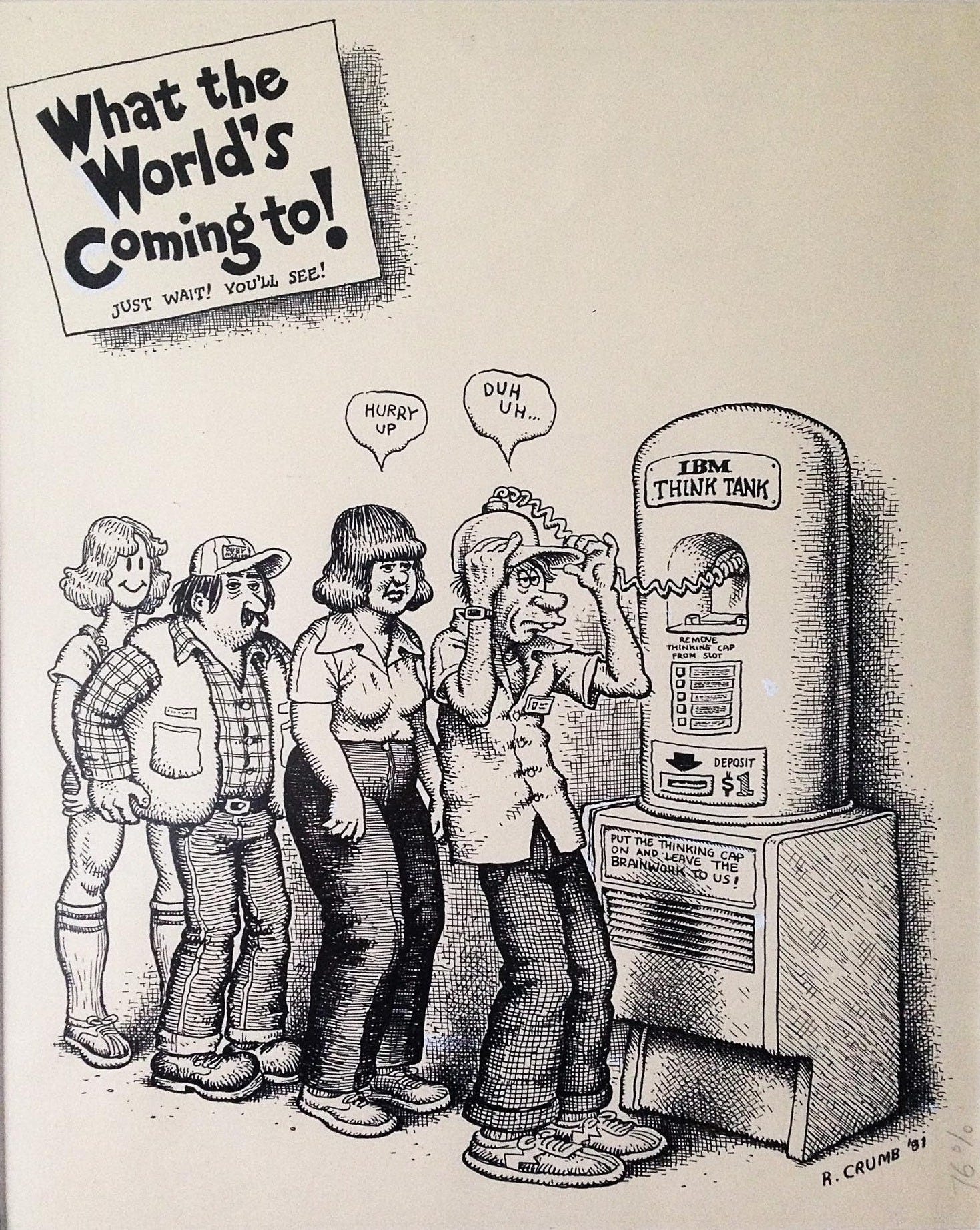
Addendum: Helicopter Story
In 2020, “I Sexually Identify as an Attack Helicopter” (later retitled “Helicopter Story”) was published in Clarkesworld Magazine and subsequently withdrawn at the request of the author after it was met with the stupidest instance of twitter cancel culture I can remember. Isabel Fall, its (trans) author, withdrew the piece and entered a psychiatric hospital after the backlash to the piece (more or less entirely due to its title) which you can read about in detail elsewhere.
I love “Helicopter Story.”
It represents, if anything, the polar opposite of the A.S.T. It is incredible “localized” in the story of one individual, one relationship, one afternoon, one military engagement. It tracks Barb, one of two biological components of a Boeing AH-70 Apache Mystic, (“America names its helicopters for the people it destroyed”) serving a U.S. military at war with the AI administrative systems of the Pear Mesa Budget Committee, a former southwestern credit union; a military “armed with functional connectome mapping and neural plastics … [has made] gender tactical.”
I am gas turbines. I am the way I never sit on the same side of the table as a stranger. I am most comfortable in moonless dark, in low places between hills. I am always thirsty and always tense. I tense my core and pace my breath even when coiled up in a briefing chair. As if my tail rotor must cancel the spin of the main blades and the turbines must whirl and the plates flex against the pitch links or I will go down spinning to my death.
An airplane wants in its very body to stay flying. A helicopter is propelled by its interior near-disaster.
“Helicopter Story” is about a lot of things. But in the main, to me, it is about what we think we know, the fear of what we don’t, and the heroism of confronting it. The hero of “Helicopter Story,” if there is one, is Barb’s co-pilot/partner’s gender dysphoria.
“We can’t do this forever,” Axis says, startling me … But who was ever only one thing?
The story is, on this level, about us, about the theoretical no man’s land we are barreling into with the lights turned off. We, too, are oscillating between deadly certainty and suicidal self-doubt. The story ends:
A search radar brushes across us, scatters off the gown, turns away to look in likelier places. The Apache’s engine growls, eating battery, turning charge into motion. The airframe shudders again, harder, wind rising as cooling sky fights blazing ground. We are racing a hundred and fifty feet above the Larger Mojave where we fight a war over some new kind of survival and the planet we maimed grows that desert kilometer by kilometer. Our aircraft is wounded in its body and in its crew. We are propelled by disaster. We are moving swiftly.
We, too, fight a war over some new kind of survival, one we can scarcely even imagine. We barrel into the future, an epistemic desert which itself grows, hungrily reaching back to meet us.
No future was really ever planned; no plan survives contact with the enemy. We have always been propelled by interior near-disaster, cycling through OODA loops of action, observation, and revision, action-reaction-rereaction. Or, per Seeing like a State, the development of civilizational metis, “knack,” arises from doing and failing and learning from failure, sometimes achingly slowly.
We will have to hypothesize about the future before we learn from our failure to prophesy. But then, we will need to fail to plan before we learn we have to start. I hope these recent conversations I’ve been tracking are the start of the end of that failure.
Swear to god I’ll post something I actually planned to write one of these days!3
These works collectively speak to the question Christopher Lockett poses in “The Implausibility of Galactic Empires,” and why, while I agree that bajillion year long empires are unrealistic, it’s for basically the same reason I agree space feudalism is my default assumption—administration over territory too large for easy communication or transportation can really only be achieved by outsourcing to whatever local authority you most trust to send tribute across deep space.
Works of the 2000s respectively that I highly recommend if one is interested in exploring speculative social systems: Anathem (2008) and Pattern Recognition (2003)
For some reason substack on my computer keeps glitching out when I try to add a caption to the subscribe button. uh just pretend this is a caption
I surmise that (in no particular order) @Lillian Wang Selonick @grischanotgriska @John Encaustum would all have interesting things to say.
As a philistine, I hardly do, though I’ll note re: “panoramic” and Farrell’s description of AST as being “often anchored in character just enough to drive the action forward”, that I was recently debating a friend on the extent to which detailed character development and worldbuilding can both happen. The context being, ofc, that hard scifi often lacks the former; and my contention is that you simply can’t offer that much psychological depth (even if you’re not portraying thought processes in extreme detail, you need to say enough for a character to be fully fleshed out) while also providing an immersive world for the reader to inhabit. I think the poli version is slightly different, somewhat more flexible (the reader doesn’t have to keep track of oodles of technobabble, for one thing), but still, ultimately characters are bit players in a really complex system….
And as for “the past’s futures”, it reminds me of this from Calvino’s Invisible Cities: “Futures not achieved are only branches of the past: dead branches.”